


It’s Okay to Wonder Where You Fit
You might be here because you tried treatment and it felt like a mismatch. Maybe you started strong, then work or family demands pulled you away. Or the structure felt too light, too harsh, or too much. If that sounds like your story—you’re in good company. Many people pause or retreat from recovery, not because they don’t want help, but because the program didn’t fit their life.
At Ascend Near Albuquerque, NM in Albuquerque, we believe choosing the right level of care matters. It’s not about being “more committed” or “less of a problem.” It’s about finding the support that honors your life—and that meets you exactly where you are. So let’s walk through two paths: intensive outpatient program (IOP) and partial hospitalization program (PHP). You’ll see what each looks like, who it fits, and how to choose what feels right.
What Is IOP?
An intensive outpatient program gives you structured support—without replacing your life.
You can expect:
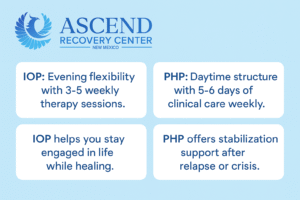
- 3–5 therapy sessions per week—typically in the evenings.
- A blend of group and individual therapy, focusing on relapse prevention and life skills.
- Flexibility to keep working, parenting, schooling, and continuing most of your daily life.
IOP isn’t a half-measure; it’s recovery with space built in. It fits your responsibilities—and still holds you accountable. You don’t leave your post at home or work. You don’t disappear. You heal in context.
What Is PHP?
A partial hospitalization program gives you deeper support, time-wise and clinically.
Here’s what PHP looks like:
- 5–6 days per week—typically daytime sessions.
- More clinical oversight: therapists, nurses, and possibly medication management.
- A structured daily schedule that takes over much of your daytime hours.
- Evenings spent at home, so you keep some ties to your life outside of care.
PHP is stronger support without living on-site. It’s helpful when outpatient therapy isn’t enough—or when you’re fresh from a crisis or relapse and need more hands-on care.
Key Differences
| Feature | IOP | PHP |
|---|---|---|
| Schedule | 3–5 evenings/week | 5–6 daytime days/week |
| Clinical Oversight | Licensed therapists | Therapists, nurses, medical staff |
| Home Life | Live at home; maintain routine | Live at home; evenings free but daytime in care |
| Best For | Starting, restarting, or sustaining recovery | Stabilizing after relapse or crisis |
| Flexibility | High | Moderate |
| Depth of Care | Recovery skills, coping strategies | Medical stabilization, clinical support |
Who Should Choose IOP?
You might benefit from IOP if any of this sounds like you:
- You tried treatment but stepped away because it felt too much.
- You have a job, kids, or responsibilities you don’t want to abandon.
- You feel your life is unsteady, but you’re not in crisis.
- You want to rebuild recovery without losing your footing at home.
- You need peer support but worry about disappearing from your day-to-day.
IOP is about staying engaged in real life—while you grow tools to handle it better.
Who Should Choose PHP?
PHP might be right if any of this hits home:
- You’ve recently relapsed or experienced a mental-health crisis.
- The structure of outpatient therapy hasn’t been enough.
- You need deeper emotional or medical support for now.
- You can’t safely manage full-time responsibilities yet.
- You’re ready for a temporary pause—a reset with guidance.
PHP is stronger scaffolding, supporting you through the toughest stretch before you step back.
It’s Not Fixed: You Can Move Between Levels
Here’s what’s most important: you’re not locked in. Most people change levels of care as recovery unfolds.
Maybe you start in IOP, realize you need more stability, and step up to PHP. Or you begin in PHP, stabilize, and step down to IOP—or even outpatient care. That’s the beauty: you stay in charge.
At Ascend Near Albuquerque, NM, our clinicians guide this journey gently—not as a one-off decision, but an ongoing conversation. We look at your day-to-day, your progress, your goals. You’re not choosing a box; you’re choosing a path that shifts as you grow.
Common Misconceptions
“More care equals more failure.”
This couldn’t be further from the truth. Choosing PHP because you need stabilization is strength, not weakness. It’s giving yourself the tools you need—when you need them most.
“IOP is less serious.”
No. IOP is serious and structured. It’s built for people who want truth, growth, and healing without derailing the rest of their life.
“I’ll be stigmatized.”
At Ascend, we see recovery as personal progress—not a march in public. Nobody tracks or judges how you walk this path. If you live near Santa Fe, our IOP in Santa Fe, NM is just as confidential, just as respectful.
Real Stories, Real Choices
Consider Maria, a working mom who tried PHP after a relapse. She figured she needed “all the help.” But daytime treatment meant long shifts with no time for her two kids—and she felt torn between recovery and motherhood. She stepped back into IOP. More flexible. She was able to attend sessions, pick up kids, and stay connected at work. That balance helped her build recovery habits in real life.
Then there’s Joe, who started IOP but struggled with regular cravings and sleep disruptions. He moved into PHP for a few weeks to stabilize. He gained momentum, then stepped back into IOP and ultimately to weekly outpatient. His recovery was stable, sustainable—and self-paced.
FAQs: Your Questions, Answered
Q. Can I switch mid-treatment?
Yes. Your path can adjust as your needs change.
Q. Which is more likely to use insurance?
Both IOP and PHP are typically covered. Our intake team will help verify your benefits.
Q. Do I have to explain missing sessions?
No judgment. Just open conversation. We’ll support and guide—not shame.
Q. Will family know where I’m going?
It’s private. Unless you choose to share. We respect your confidentiality under HIPAA.
Q. How long does each program last?
Everyone’s timeline is different. Generally PHP lasts weeks to a couple of months. IOP can bridge weeks, months, or overlap outpatient care. Duration is tailored to your progress.
Q. Is medication support available?
Yes. Especially in PHP, where medical specialists can help if needed. We integrate holistic care as required.
Q. What happens after IOP or PHP?
We don’t drop you off at the curb. Ascend offers alumni groups, outpatient therapy, and step-down programs to maintain progress and connection.
Final Thought
Recovery isn’t a staircase—you don’t start at the bottom and march upward in a fixed order. It’s more like choosing the right shoe for the terrain you’re walking today. Whether it’s the flexibility of IOP or the support of PHP, the right fit lets you walk steadily—not stumble, not stand still.
At Ascend Near Albuquerque, NM, we believe your treatment should walk with you—not ahead of you or behind you. It listens. It adapts. It answers your needs.
Ready to find the level that fits your life?
Call (888)533-9334 or visit our intensive outpatient program in Albuquerque, Near Albuquerque, NM to explore IOP, PHP, or whatever comes next for you.
