


What if your life looks okay—but your heart keeps asking for more?
That quiet question is often the first sign something deeper is shifting.
Maybe you’re curious about what life would feel like without substances. Maybe you’re trying to change—but old patterns keep pulling you back. You don’t feel like you’re in crisis, but you’re not exactly thriving either.
If you’ve been exploring therapy, reading recovery books, or dipping your toes into sobriety—but still feel unsure or stuck—a residential treatment program Near Albuquerque, NM might offer the structure, support, and space you’ve been missing.
Let’s walk through how to know if that next step is right for you.
1. Outpatient Isn’t Getting to the Root
Maybe you’ve done therapy. Maybe you’ve tried IOP (Intensive Outpatient), joined online groups, or talked things through with friends. But the patterns keep repeating. You get a little better, then feel like you’re right back where you started.
That’s not failure. That’s a sign the problem isn’t surface-level.
Residential treatment lets you take a break from managing your everyday life so you can dig deeper. It’s not about fixing you. It’s about finally having the time and support to understand why you feel the way you do—and what will actually help you feel different.
2. Your Environment Is Part of the Problem
Change is hard when you’re still surrounded by the same stress, noise, or triggers. Even small things—like a group of friends who always drink, or a job that drains you—can keep you in cycles you’re trying to escape.
In a residential setting, your environment becomes your ally instead of your obstacle.
You’re surrounded by people who understand what you’re going through. The day is structured to support your healing. You don’t have to explain or justify your choice to change—because everyone there is choosing the same.
Whether you’re from Santa Fe or Las Cruces, our residential treatment center in Albuquerque offers a calm, welcoming space to focus on yourself.
3. You’re Tired of Doing This Alone
One of the biggest signs it’s time for residential care is emotional exhaustion.
You’re not necessarily in crisis. But you’re tired. Tired of managing your feelings alone. Tired of trying to “figure it out.” Tired of wondering if it’s even worth it.
In residential treatment, you don’t have to hold it all together.
Support is built into every part of the day—from meals, to therapy sessions, to quiet reflection time. You’re not alone in your questions or your healing.
4. You’re Looking for More Than Just Sobriety
If you’re exploring sobriety but not sure where you fit on the spectrum, you’re not alone.
Many people in residential treatment are “sober curious” rather than fully identifying with addiction. They’re not waiting for rock bottom. They’re just ready to feel better—and suspect that substances might be getting in the way.
A residential program doesn’t label you. It helps you understand your relationship with substances (and with yourself) in a deeper, more personal way.
You don’t have to be addicted to deserve help.
5. You’re Functioning—But Not Fully Living
This one is subtle but important.
From the outside, things might look fine. You’re working. You’re parenting. You’re showing up. But inside, it feels… flat. Maybe anxious. Maybe disconnected.
You’re doing everything “right,” but it still doesn’t feel good.
That emotional disconnect is often a sign that something deeper needs attention. Residential care gives you space to press pause, listen to what your mind and body are really saying, and explore a new kind of connection—to yourself and others.
6. You’re Ready for a Full Reset
Sometimes, you just know: You need a reset.
Not a vacation. Not a new habit. A full, supported pause. A chance to step out of your routine and ask: What do I really need right now?
Residential treatment is that pause. A reset with professionals who care, peers who understand, and a plan to help you reconnect to what matters.
Signs You Might Benefit from Residential Care
Even if you’re not sure, these gentle indicators can help guide you:
- You’ve tried outpatient care but still feel stuck.
- You’re hiding your struggles from others—even those closest to you.
- Your mental health is affecting your sleep, appetite, or energy.
- You want to explore sobriety but don’t feel safe doing it alone.
- You feel like something’s missing, even if you can’t name what.
If even one of those feels true—you’re not too early, too complicated, or too “functional” to explore residential care.
Frequently Asked Questions
What’s the difference between outpatient and residential treatment?
Outpatient care means you live at home and attend therapy or groups during the day or evening. Residential treatment means you live at the treatment center full-time, giving you 24/7 support and a more immersive experience.
Residential care is often a better fit if your environment isn’t supportive, if you need a break from stressors, or if outpatient care hasn’t been enough.
Do I have to identify as an addict to enter residential treatment?
No. At Ascend, we meet you where you are. Whether you’re sober curious, actively using, or somewhere in between, you’re welcome here. We believe healing is personal—not one-size-fits-all.
How long does residential treatment last?
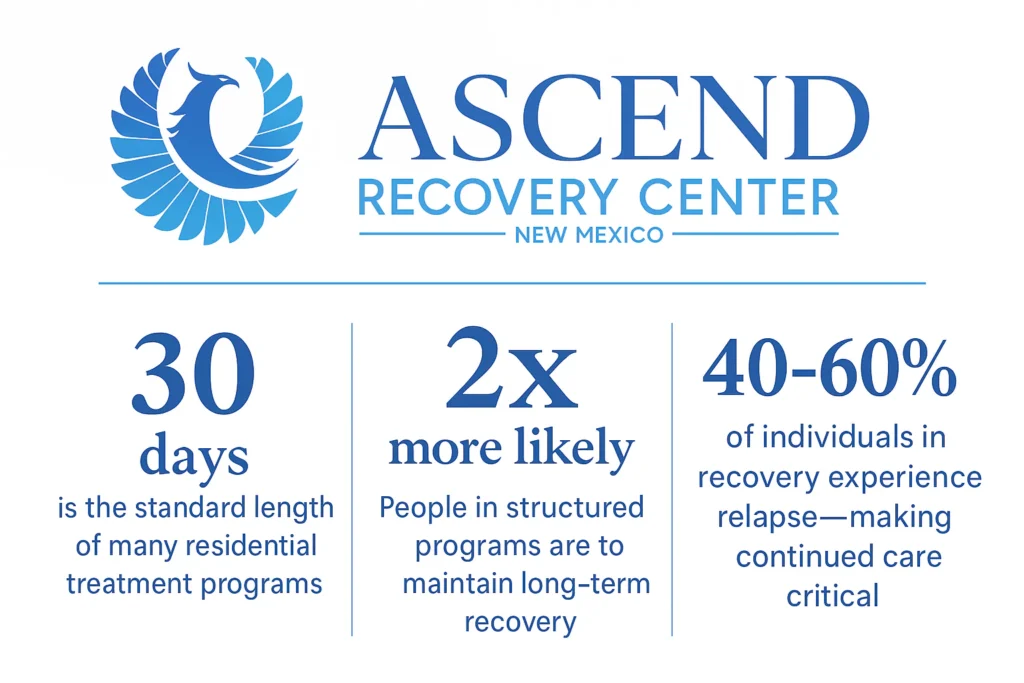
Our residential treatment program is typically 30 days, but we work with you to find the length of stay that best supports your goals. Some stay longer. Others transition to outpatient care after a few weeks.
What does a typical day look like?
You’ll have a structured schedule that includes therapy, group sessions, wellness activities, and time to reflect or rest. Meals are shared, support is ongoing, and every day is designed to support healing.
Will I lose my job if I go to residential treatment?
Not necessarily. In many cases, you may qualify for medical leave under the FMLA (Family and Medical Leave Act). We can help you understand your options and provide documentation as needed.
📍Whether you’re exploring care near home or looking for a change of environment, our residential treatment program in Albuquerque, Near Albuquerque, NM welcomes individuals from across the state, including Rio Rancho and beyond.
📞 You Deserve to Feel Better—And Supported While You Heal
Call us at (888) 533-9334 or visit our Residential Treatment Program page to learn more about how Ascend Near Albuquerque, NM can help.
Your healing doesn’t have to wait for a crisis. You’re allowed to want more peace—right now.
