


When I first walked into PHP, I didn’t know where to sit. Or what to say. Or if I belonged there at all.
Early recovery has a strange silence to it. It’s not loud like the chaos was. It’s just…quiet. Still. And sometimes that stillness feels unbearable.
If you’re wondering what happens inside a Partial Hospitalization Program, this is for you. These answers won’t fix everything. But they might make the first step feel less lonely—and a little more possible.
What do the first few days of PHP actually feel like?
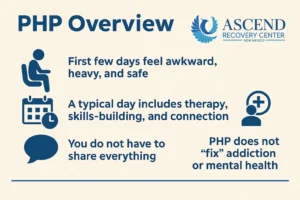
They feel awkward. And heavy. And safe—eventually.
Most people don’t show up to PHP with a suitcase full of confidence. You might feel fragile, or foggy, or flat. Some people are emotional right away. Others sit in silence for a few days, just trying to breathe without panicking.
The good news? The room knows how to hold you. The structure is there for a reason. You won’t be asked to perform. Just show up.
By the end of the first week, most people don’t feel “healed.” But many feel a little less like they’re falling—and more like they’re being held.
What do you actually do all day in a Partial Hospitalization Program?
It’s a mix of therapy, skills-building, and structured connection.
At Ascend Near Albuquerque, NM, a typical PHP day lasts about six hours. It usually includes:
- Morning check-ins: Light structure to help you ground and name how you’re doing.
- Group therapy: Focused on topics like grief, relapse, boundaries, identity, self-worth, and rebuilding trust.
- Individual sessions: Time with your primary therapist to dig into personal themes.
- Psychoeducation and life skills: Think mindfulness, distress tolerance, communication, nutrition, coping tools.
- Breaks and meals: Not just logistical—these moments are part of healing your nervous system.
- Optional family sessions: If and when you’re ready, families can be invited into the process.
The rhythm matters. The repetition helps your brain trust that safety isn’t just an idea—it’s a structure.
Do I have to share everything with the group?
Not at all. You set your own pace.
In PHP, nothing is forced. You won’t be pressured to cry or tell your life story. Most people don’t “open up” in big dramatic ways. They start small. A head nod. A shared laugh. A “me too.”
And when someone else says something you’ve never said out loud? That’s when healing often begins.
You might find that listening is how you start to feel less alone.
Is everyone else going to be further along than me?
Honestly? Everyone thinks that at first.
It’s easy to look around and assume other people are doing better. But recovery doesn’t move in a straight line. Some clients are detoxing. Some are coming back after a relapse. Some are starting over—again.
You’re not late. You’re not behind. You’re in.
And if you’re looking for a Partial Hospitalization Program outside Albuquerque, know that Ascend also serves nearby areas like Las Cruces and Rio Rancho. You’re not alone in this corner of Near Albuquerque, NM.
Will PHP fix my addiction or mental health problems?
PHP isn’t a cure. It’s a reset.
Addiction and mental health issues don’t disappear in 30 days. But they can soften. They can shift. They can become something you understand, instead of something that controls you.
PHP gives you the tools, time, and support to stop spiraling—and to start building a life you actually want to stay in.
You’ll leave with more than coping skills. You’ll leave with language, structure, and practice. And maybe, even a little bit of self-respect again.
What if I don’t feel “sick enough” for PHP?
So many of us wait until we hit the wall—until we can’t get out of bed or keep our stories straight.
But PHP isn’t just for rock bottom. It’s for anyone who needs more support than weekly therapy can give. If your days feel unmanageable, your thoughts feel loud, or your motivation keeps disappearing… it’s enough.
Needing help doesn’t mean you failed. It means you’re still fighting.
Can I work or go to school during PHP?
Probably not full-time—but there’s a plan for that.
PHP usually runs during business hours, so full-time work or school might need to pause. But this is temporary. Many clients return to class or part-time work after PHP, with more stability and confidence.
If that idea makes your stomach drop, you’re not alone. Letting go of your schedule—even briefly—can feel like failure. But what if this pause is the reason you can keep going later?
Ascend’s team will help you plan for that. They don’t expect you to drop your life. They help you build a life that can hold you.
What happens after PHP ends?
The truth? This part can be scary.
PHP gives your life a frame. When it ends, it’s normal to feel exposed again. That’s why planning your next steps starts early.
You and your treatment team will build a transition plan. It might include:
- Stepping down into an IOP (Intensive Outpatient Program)
- Continuing with weekly therapy or psychiatry
- Joining support groups or alumni programs
- Mapping out a healthy weekly routine that works in real life
At Ascend, they don’t just wave goodbye. They walk with you until your next steps are solid.
What makes Ascend’s PHP different?
It’s not just the clinical care—it’s the atmosphere.
At Ascend, people are treated like people. Not numbers. Not diagnoses. Not broken projects. The staff sees you. And many have walked this road themselves.
Plus, the program is local. Whether you’re in Albuquerque, Santa Fe, or a nearby community, you’re not being shipped off to a place that feels foreign. You’re healing in your own region. That matters.
What if I feel too broken for this?
You’re not.
Early recovery is like waking up in a house you burned down. It’s hard to believe anything beautiful could live here again. But it can.
You are not too broken. You’re just tired. And raw. And maybe still carrying a grief you don’t have words for.
In PHP, you don’t have to have hope. You just have to let someone else hold it for you until you can again.
Will I have to talk to my family?
Only when (and if) you’re ready.
Family sessions are offered—but never forced. Many people need time to get steady before opening that door. Some families aren’t safe to involve, and that’s respected too.
If you do choose to include family, Ascend helps create boundaries, scripts, and safe containers for those conversations.
You lead the pace. The team supports the process.
Can I relapse during PHP?
Yes. And if you do—you’re still welcome.
Relapse isn’t the end of the road. It’s often part of it. The staff at Ascend won’t shame you. They’ll help you make sense of what happened and what you need next.
Recovery isn’t about being perfect. It’s about not disappearing when things get hard.
I don’t think I belong in treatment. Is that normal?
Yes. Most people walk in feeling like imposters.
We tell ourselves others had it worse. That we’re just being dramatic. But pain is pain. Disconnection is disconnection. If you’re hurting, if you’re hiding, if you’re scared—this space is for you too.
Belonging doesn’t happen overnight. But over time, as you hear yourself in others and feel yourself being seen, something shifts.
And when that shift happens? Everything changes.
Ready to Take the First Step?
If you’re feeling raw, lonely, or unsure if you’re “ready,” you’re not alone. You don’t have to do this perfectly. You just have to start.
Call (888) 792-5442 or visit Ascend’s Partial Hospitalization Program in Albuquerque to learn more. You deserve real support, not just survival
