


Watching your child struggle with alcohol—especially after they’ve already been through treatment—is a heartbreak that doesn’t come with a manual.
You’ve tried tough love. You’ve tried gentle support. You’ve walked the tightrope between stepping in and stepping back so many times it feels like second nature now. And still, here you are—tired, scared, and trying to figure out what comes next.
This FAQ is for you. If you’re a parent considering an alcohol detox program in New Mexico for your adult child—or simply trying to hold the line without losing yourself—this is a place to find clarity, not judgment. A place to name your fears, and maybe feel a little less alone in them.
What is an alcohol detox program, and how does it help?
Detox is the first medical step in the recovery process. When someone has been drinking heavily or frequently, suddenly stopping can lead to serious withdrawal symptoms. These aren’t just uncomfortable—they can be dangerous.
That’s where a professional alcohol detox program comes in. At Ascend, we provide:
- 24/7 medical monitoring
- Medication to ease withdrawal symptoms
- Supportive, private environment
- Structured next-step planning
We serve individuals across New Mexico—including Santa Fe, Las Cruces and Las Cruces, NM—and we make sure detox isn’t just physically safe, but emotionally humane. We treat clients with dignity, not discipline.
How do I know if my child needs alcohol detox?
Here are a few red flags to pay attention to:
- They get sick, shaky, or sweaty when they stop drinking—even for a few hours.
- They drink first thing in the morning to “feel normal.”
- They’ve tried to stop but always end up back in a cycle.
- Their use is escalating despite consequences.
- You notice emotional or behavioral changes—irritability, isolation, or lying.
Sometimes, it’s not about a dramatic moment. Sometimes it’s a quiet realization: This is getting worse, not better. That’s enough reason to reach out.
What’s the difference between support and enabling?
It’s one of the hardest questions for parents—especially when love makes it hard to say no.
Support helps someone move toward recovery.
Enabling helps them avoid consequences—even when it hurts them long term.
Support sounds like:
- “I will drive you to detox. I can’t do this for you, but I’ll walk beside you.”
- “I love you too much to pretend this is working.”
- “I’ll help you with treatment—but I won’t help you keep drinking.”
Enabling sounds like:
- Covering rent while they drink away their income.
- Making excuses for missed work or school.
- Avoiding hard conversations to “keep the peace.”
Setting boundaries isn’t punishment. It’s protection—for them and for you.
What if I suggest detox and they refuse?
It happens. A lot.
You might feel helpless, like you’ve reached your limit and it still isn’t enough. But refusal doesn’t mean you’ve failed. It means they’re still fighting against something they don’t fully understand—or aren’t ready to face.
You can’t force them into willingness. But you can do the following:
- Keep the door open. Let them know detox is available when they’re ready.
- Set clear limits. “I can’t support your drinking, but I’ll support your recovery.”
- Hold your ground with compassion. No yelling. No begging. Just truth.
It’s not about being cold. It’s about being consistent—and loving them enough to step back when you need to.
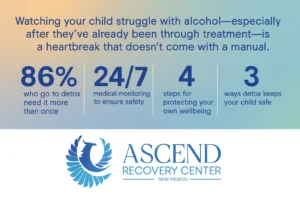
Is it common for people to return to detox more than once?
Yes. And it’s not failure.
Many people cycle through periods of trying, stopping, and starting again. Recovery isn’t linear. Detox can be necessary more than once—not because the person is doing it wrong, but because recovery takes what it takes.
At Ascend, we treat every return not as a failure, but as another brave step forward. If your child is back at square one again, that doesn’t mean they’ve lost their chance. It means they still have one.
What can I do while they’re in detox?
Breathe.
Seriously—detox isn’t just a pause for your child. It’s a moment for you to take your hands off the wheel and care for yourself, too.
Here are a few ways to use the time:
- Talk to someone. A therapist, support group, or trusted friend. You need a space that’s yours.
- Sleep. Eat. Journal. Your basic needs matter.
- Avoid “what if” spirals. Stay in the present. Let the professionals handle the care.
- Start gathering information. What comes after detox? What are your boundaries going forward?
This is a window of safety. Use it to restore your own strength.
What happens after detox?
Detox is just the beginning. Once the body stabilizes, the real emotional and behavioral work begins.
After detox, many clients continue into:
- Residential treatment (structured daily care)
- Outpatient programs (flexible, community-based support)
- Therapy and medication support
- Peer support groups
- Family education and involvement
At Ascend, we don’t just discharge someone and wish them luck. We walk families through next steps, making sure everyone is supported—not just the person in treatment.
Can I visit or talk to my child during detox?
Yes—with their consent. We honor privacy laws and emotional readiness.
If your child gives permission, we can:
- Keep you updated on progress
- Help coordinate aftercare planning
- Support family communication when it’s safe and appropriate
Even if contact isn’t possible during detox, you’ll still have a role. You’re part of the story, even when you’re not in the room.
How do I support them without burning out again?
This is where boundaries become a lifeline.
Burnout often comes from over-functioning—doing more than your share, emotionally or logistically. Recovery can’t happen if you’re carrying the entire weight.
To stay supportive and whole, try this:
- Stick to what’s yours. You’re a parent, not a therapist.
- Say what you mean. Clarity helps more than over-explaining.
- Let go of outcomes. You can’t control their choices.
- Get your own support. Al-Anon, family therapy, peer groups—your healing matters, too.
Boundaries aren’t walls. They’re railings. They help both of you stay upright.
Is there really hope, even if this keeps happening?
Yes.
Hope doesn’t always come wrapped in neat timelines or clean endings. Sometimes it looks like a second detox. Sometimes it looks like a parent holding the line with tears in their eyes. Sometimes it’s just one quiet morning where no one is drinking—and that’s enough for today.
Relapse doesn’t erase progress. Returning to detox doesn’t undo recovery. Every time your child chooses life, even imperfectly, hope grows a little stronger.
You are not naive for holding on to it. You’re brave.
You’re Doing More Than You Know
If you’re scared, worn out, or wondering what else you could possibly do, you’re not alone. Being a parent in this space is one of the hardest things there is.
But asking questions? That’s strength. Reaching out? That’s love in action. You don’t have to carry this alone anymore.
Call (888) 792-5442 or visit Ascend’s alcohol detox program services in Albuquerque, New Mexico to talk with someone who understands what families face—and how recovery can begin again, with care and without shame.
