


You love someone who’s using. You live with it, sleep next to it, explain it to the kids, manage it in public. You’re not the one drinking, popping pills, or lying — but somehow, you’ve ended up managing the fallout anyway.
You’re not broken. You’re not crazy. You’re someone trying to love a person in the grip of something that keeps breaking both of you.
If you’re here wondering whether a Medical Detox Program in Albuquerque is the right next step — or whether helping them find one is “too much” — you’re already doing something powerful. You’re thinking about how to stop surviving and start supporting in a way that actually helps.
This isn’t a guide for fixing anyone. It’s a guide for finding your footing again.
What’s the Line Between Helping and Enabling?
If you’ve googled this more than once, you’re not alone. Most partners in your position have felt this tension for months, maybe years.
Helping is support that holds someone accountable to truth.
Enabling is rescuing them from the consequences of that truth.
Here’s what that looks like:
Helping:
- Saying “I love you and I won’t lie for you.”
- Recommending detox or calling for info.
- Refusing to give money you know will go toward using.
- Making space for honesty without shame — and still holding boundaries.
Enabling:
- Covering for them when they miss work or family events.
- Letting them talk you out of every boundary.
- Taking the blame when they spiral.
- Making recovery your responsibility.
Helping might make things messier before they get better. Enabling can keep things calm on the surface — while everyone silently sinks.
What Does a Medical Detox Program Actually Do?
A medical detox program is the clinical, supervised process of removing drugs or alcohol from someone’s system while protecting their body from dangerous withdrawal symptoms.
At Ascend Near Albuquerque, NM, detox is not a jail, not a boot camp, and not a scare tactic.
It’s a place where people who have been drinking, using opioids, benzos, or other substances:
- Receive 24/7 monitoring to manage symptoms safely
- Get medication support to reduce anxiety, pain, and risk
- Stabilize enough to think clearly again
- Experience a break from chaos — and often sleep better than they have in weeks
Medical detox isn’t treatment — it’s a doorway to it. Think of it like a surgical prep room. If someone is bleeding internally, you stabilize them before therapy or surgery begins. Detox stabilizes the body. The emotional work can start after.
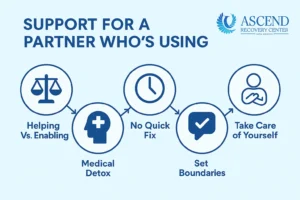
Will Detox Fix Them?
No — but it might wake them up.
A lot of partners wait to get involved until things are dire: an overdose, a DUI, a blowout fight. But it doesn’t have to go that far.
Here’s what detox can do:
- Help them survive quitting something dangerous
- Interrupt the physical dependence cycle
- Provide clarity and readiness for the next phase of treatment
- Give you both a break from the noise — and space to breathe
What it can’t do is force them to stay sober. Detox is a start, not a solution. But starts matter.
What If They Refuse?
Then you protect your peace. You cannot drag someone into change. But you can:
- Say, “I won’t stay in this cycle with you.”
- Set financial, emotional, or relationship boundaries.
- Offer the option, clearly: “This is where I’m willing to meet you if you’re serious.”
- Let them feel the discomfort of their own consequences.
Some people don’t change until the pain of staying the same finally outweighs the fear of changing.
And if you need backup in navigating that? Our team is here to talk — even if your partner isn’t ready yet. If you’re located in areas like Santa Fe or Las Cruces, we offer support across Near Albuquerque, NM, not just in Albuquerque.
What If They’re Still Lying?
They might be. Addiction distorts reality. It convinces the user they’re fine — and convinces the people around them that they’re being unreasonable for questioning it.
If they say things like:
- “I’ve got it under control.”
- “You’re the one with the problem.”
- “I don’t need detox, I just need to slow down.”
…and then keep spiraling, you’re not imagining it. And you don’t have to keep arguing. Truth doesn’t need to yell.
Sometimes your peace starts with accepting that you see what you see — and no longer need their permission to respond to it.
What Happens After Detox?
Detox is usually a short-term stay — 3 to 7 days. After that, the path varies. Some options include:
- Residential Treatment: A longer stay with therapy, structure, and no outside triggers
- Partial Hospitalization Program (PHP): Daily support with return home at night
- Intensive Outpatient Program (IOP): Group and individual therapy while maintaining work/life balance
- Medication Support: Especially for dual diagnoses (depression, anxiety, etc.)
Your partner may want to leave detox and go home. That’s common. But detox often softens the resistance to more care — because they’re finally thinking clearly.
What If They Relapse?
Then you respond, not react. Relapse doesn’t erase progress. But it does require a return to truth.
You can say:
- “I’m not doing this cycle again. If you want to get back on track, I’ll help — but I won’t lie, cover, or lose myself again.”
- “Your relapse doesn’t make you a failure. But it does mean you need help again.”
- “I care about your life. That’s why I can’t pretend this is okay.”
You’re allowed to grieve, cry, rage, and set a boundary. Even if they relapse — especially if they relapse.
What About Me? I’m Falling Apart.
Of course you are.
You’ve likely been managing their emotions, protecting their image, juggling kids or bills or jobs — and feeling invisible the whole time.
You deserve your own care.
That might look like:
- Al-Anon or SMART Recovery for families
- Individual therapy to process resentment, grief, guilt, exhaustion
- Support from people who don’t say “Why don’t you just leave?”
- Letting go of the idea that love means loyalty no matter the damage
You’re allowed to stop being their emergency contact and start being your own.
FAQs for the Partner Doing It All
Can I call about detox even if they’re not ready?
Yes. We can answer your questions, give you language, and walk you through the what-ifs.
What if they leave detox early?
It happens. But it still plants a seed. And it shows them that you’re willing to support real change — not cycles.
Is it selfish to set boundaries?
No. It’s survival. And it models what healthy love looks like — even when they can’t see it yet.
Can I visit them in detox?
Each program is different. At Ascend, we prioritize safety and privacy, but we’ll guide you in how to stay connected supportively.
What if I don’t know if I want to stay in the relationship?
You don’t have to decide today. You just have to start choosing you too.
Do you support families too?
Yes. You matter. We’ll talk with you — even if your loved one never walks through our doors.
You’re Still Here. That Means Something.
You’ve read this far. That means you’re not done hoping — even if you’re tired.
You can love someone without losing yourself.
You can want them to heal without fixing it all for them.
You can ask for help — not just for them, but for you.
Call (888) 792-5442 to learn more about our Medical Detox Program services in Albuquerque, Near Albuquerque, NM.
Even if they’re not ready, you can be.
