

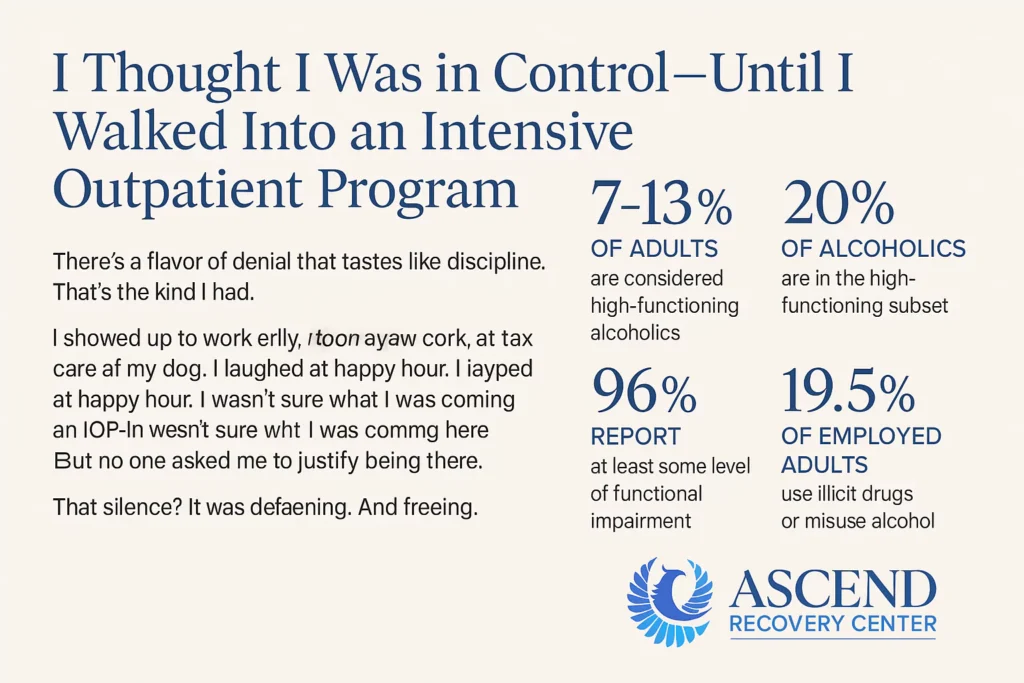
There’s a flavor of denial that tastes like discipline. That’s the kind I had.
I showed up to work early. I took care of my dog. I laughed at happy hour, even when I was already two drinks in before I got there. From the outside, it looked like I had my life together.
So when I walked into my first group session at Ascend’s Intensive Outpatient Program in Albuquerque, Near Albuquerque, NM, I wasn’t sure what I was doing there. I hadn’t “lost everything.” I hadn’t crashed a car. I hadn’t even told anyone I was coming.
But no one asked me to justify being there. That silence? It was deafening. And freeing.
When High-Functioning Becomes High-Stakes
We don’t talk enough about the addicts who don’t “look like addicts.”
Because I had a LinkedIn profile, not a mugshot. Because I could crack a joke in meetings and get my reports in on time. Because I still had friends, a gym membership, and a favorite brunch spot. I thought I was okay.
But “okay” isn’t the same as healthy. And just because I hadn’t lost everything didn’t mean I wasn’t losing myself.
I wasn’t drinking for fun anymore. I was drinking to avoid the part of me that knew something was wrong.
IOP Wasn’t What I Expected—And Thank God for That
I pictured group therapy as a circle of people in crisis. Crying. Rock bottom stories. Someone throwing a chair, maybe?
Instead, I found a room full of people like me.
Some were professionals. Some were parents. Some were young, some older. What we shared wasn’t how our lives looked—it was how we felt behind the scenes. Exhausted. Tense. Fractured.
What blew me away was how quickly I exhaled. For the first time in years, I didn’t feel like I had to prove anything. I just got to be a human being in a room full of other human beings trying to figure their stuff out.
“Functioning” Is Not the Same As Thriving
Let me say this plain: functioning doesn’t mean you’re free.
I had normalized a level of stress and shame that was eroding me from the inside. I built a life that looked strong but felt like a Jenga tower. One bad night, one forgotten story, and it could all fall.
In IOP, I learned that freedom isn’t about being able to drink without getting caught. It’s about not needing to drink to feel okay. And that? That was a game-changer.
It Took Me Weeks to Say the Word “Addiction”
The word felt too dramatic. Too big. Like it belonged to someone else’s life—not mine.
But the real shift came when one of the group facilitators asked, “What are you afraid sobriety will take away?”
That question cracked me open.
I was scared of being boring. Of losing my edge. Of not knowing who I was without the crutch of a few drinks or a couple pills to smooth the edges.
But what I found, slowly and clumsily, was that sobriety didn’t take things away. It gave me things I didn’t know I was missing: clarity, self-respect, peace.
You Don’t Have to Shatter to Start Over
I didn’t wake up on the floor. I didn’t get arrested. No one gave me an ultimatum.
I just got tired.
Tired of explaining away hangovers. Tired of managing two versions of myself. Tired of being “on” all the time.
If you’re living in that place—if you’re googling phrases like “do I have a problem?” between emails—you don’t have to wait for everything to collapse.
There’s help that meets you where you are. Especially if you’re in Albuquerque, or even nearby cities like Las Cruces or Rio Rancho, Ascend makes it easy to walk through the door—before you fall through it.
What IOP Actually Looks Like (And Why It Works)
Three days a week. Group sessions. One-on-one counseling. Optional family sessions.
No overnight stays. No being cut off from the world.
It gave me structure without suffocation. Accountability without judgment. Support without shame.
It wasn’t about hitting rock bottom. It was about building something real from the middle.
And the middle is a great place to begin.
I’m Still High-Functioning. I Just Don’t Have to Hide Anymore
I didn’t lose my personality in recovery—I got to meet it for the first time without the filter of substances.
Today, I still have a job, a dog, a life. But now, it’s one I actually want to be present for.
And that? That’s real control.
Frequently Asked Questions About Intensive Outpatient Programs
What is an Intensive Outpatient Program (IOP)?
An IOP is a structured treatment option for substance use or mental health conditions that allows you to receive professional help without staying overnight at a facility. It typically includes group therapy, individual counseling, and skill-building sessions, several times a week.
Do I have to identify as an “addict” to go to IOP?
No. Many people enter IOP without using any labels. What matters is how you feel—and whether substances are interfering with the life you want to live. If you’re asking the question, you’re likely ready for support.
Can I still work while attending IOP?
Yes. That’s one of the main advantages of IOP—it’s designed for people who need support while continuing their daily responsibilities. Most programs offer flexible scheduling, especially those like Ascend’s IOP in Albuquerque.
Is IOP only for people in crisis?
Not at all. IOP is a great option for people who are functioning externally but struggling internally. You don’t have to wait for things to get worse to get better.
What happens after IOP?
Most people transition into ongoing therapy, support groups, or alumni programs. Ascend also provides continuing care planning so you can build on your progress without losing momentum.
You Don’t Have to Explain Yourself
If any part of this hit close to home, you don’t need to justify reaching out. You don’t need to be falling apart to deserve help. You just need to be tired of holding it all together alone.
📞 Call (888)533-9334 or visit Ascend’s Intensive Outpatient Program page to learn more about services in Albuquerque, Near Albuquerque, NM. This could be your first honest step—before the crash.
