


When your child is using again, everything inside you sounds the alarm—fear, guilt, grief. Maybe it’s not as dramatic this time. No overdose. No arrest. But the signs are back: withdrawn phone calls, erratic sleep, stories that don’t quite add up. You’ve been here before, and your gut says something’s not right.
But what do you do when it’s not bad enough for the ER… yet? When they’re still functioning, sort of, but clearly struggling?
That’s exactly where a Partial Hospitalization Program (PHP) comes in—and for many families, it’s where healing truly begins.
What Is a Partial Hospitalization Program?
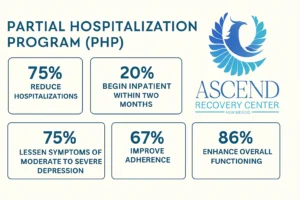
A Partial Hospitalization Program is one of the most supportive outpatient options available in mental health and addiction treatment. At Ascend Recovery Center in Albuquerque, Near Albuquerque, NM, PHP involves attending care five days a week, typically for 4–6 hours per day. Clients return home at night, but during the day, they receive a structured mix of:
- Group therapy sessions
- Individual counseling
- Psychiatric evaluation and medication management (if needed)
- Skills-based recovery education
- Family support opportunities
Think of PHP as a bridge. It supports people who need more than a weekly therapy session but don’t require round-the-clock supervision. It’s ideal for someone whose symptoms are serious—but still manageable with the right support system.
Why PHP Can Be the Turning Point for Families
For many parents, the hardest part isn’t finding help—it’s knowing when help is needed. A young adult who’s spiraling doesn’t always look “sick enough.” Maybe they’re still going to work. Maybe they’re showing up for dinner. But you can tell their light is dimming.
PHP provides a middle ground between waiting too long and overreacting. And perhaps most importantly: it gives your child the chance to re-engage with care in a way that feels less intimidating.
This level of care is about stabilization and rebuilding—not punishment, not lockdown, and not failure.
Signs Your Young Adult May Benefit from PHP
Every situation is unique, but here are a few signs PHP might be the right level of care:
- They recently relapsed after a period of sobriety or treatment
- Anxiety, depression, or emotional outbursts are increasing
- They’re isolating or withdrawing from family and friends
- You feel like you’re managing their life more than they are
- They’ve tried outpatient therapy but it wasn’t enough
- They’re asking for help—but resisting inpatient or residential treatment
If you’re reading this and silently checking boxes, trust that your instincts matter. You’re allowed to take this seriously even if things don’t look “bad enough” on the outside.
What the Day-to-Day in PHP Looks Like
Structure is what makes PHP work. At Ascend, clients typically:
- Attend five treatment days per week
- Participate in trauma-informed therapy and recovery-focused groups
- Meet with licensed clinicians to address co-occurring mental health needs
- Learn and practice emotional regulation, communication, and coping skills
A typical day might include a mindfulness check-in, a process group centered on identity or self-esteem, a clinical group on navigating family roles, and a one-on-one session with a counselor.
Meals, movement, breaks, and rest are also part of the rhythm—not just for the body, but for the nervous system. It’s recovery without the harsh fluorescent lights and cold hospital trays many parents fear.
PHP vs IOP vs Inpatient: What’s the Difference?
Here’s a breakdown to help visualize where PHP fits:
| Level of Care | Time Commitment | Environment | When It’s Used |
|---|---|---|---|
| Inpatient / Residential | 24/7 | Stay overnight | For acute mental health or substance use crises |
| PHP (Partial Hospitalization Program) | 4–6 hours/day, 5 days/week | Home at night | When outpatient isn’t enough, but residential isn’t necessary |
| IOP (Intensive Outpatient Program) | 3 hours/day, 3–5 days/week | Home-based | Step-down from PHP or early recovery support |
PHP is especially helpful as a step up from outpatient or down from inpatient, depending on where someone is in their recovery journey.
What Parents Are Saying About PHP
Some of the most powerful feedback we hear doesn’t come from the clients themselves—it comes from the parents.
“He wasn’t ready to live at a facility again. But he kept saying he needed help. PHP gave us the answer we didn’t know existed.”
– Parent of Ascend PHP client, 2023
“It was the first time I wasn’t terrified to leave him alone at night. I knew someone else was holding the reins during the day.”
– Albuquerque mother, 2022
“I thought I’d have to quit my job again. But this time, Ascend had structure for him—and support for us.”
– Father of 22-year-old client
The Parent’s Role in PHP—and Why It Matters
At Ascend, families are not sidelined. In fact, parents and caregivers are often vital to the healing process. Our clinicians offer:
- Weekly family sessions (virtual or in-person)
- Psychoeducation about mental health and substance use
- Support in setting boundaries that are healthy—not harsh
- Guidance around reentry, transitions, and life outside treatment
We know how heavy this has been for you. You’ve been carrying more than your share for too long. PHP gives you the relief of knowing your child is being held—clinically, emotionally, and safely.
Local Access: Partial Hospitalization Program Near Albuquerque, NM
If you live in or near Albuquerque, Ascend’s PHP offers immediate access to care that’s rooted in the local community. We also work with families coming from nearby cities, including:
- Partial Hospitalization Program in Las Cruces, Near Albuquerque, NM
- Partial Hospitalization Program in Rio Rancho, NM
No matter your zip code, you deserve to know what’s available—not just what’s urgent. PHP might be that bridge for your child, and for you.
Frequently Asked Questions About PHP for Young Adults
How long does someone stay in PHP?
Most PHP programs last between 2–6 weeks, depending on individual needs. At Ascend, treatment plans are reviewed regularly and adjusted based on progress.
Is PHP covered by insurance?
Yes—many private insurance plans cover Partial Hospitalization Programs. Our team can verify your benefits and walk you through any out-of-pocket costs.
What if my child refuses PHP?
It’s common for young adults to hesitate. We offer family consultations to explore how to approach this conversation in a way that supports connection, not conflict.
Does PHP treat mental health and addiction?
Yes. Ascend’s PHP is designed to address both substance use and co-occurring mental health issues like depression, anxiety, or trauma.
Can they work or attend school during PHP?
Because of the daytime hours, most clients pause work or school while attending PHP. However, our team helps plan for reintegration and academic support during transition.
Final Thought for Parents Holding the Middle
If you’ve been told to wait until it gets worse… you don’t have to. PHP exists because people get help before things completely fall apart.
You are not overreacting. You are not failing. You’re doing what you’ve always done—trying to protect and support someone you love.
Let us be part of that support system.
Ready to Take the Next Step?
Call (888) 792-5442 or visit our Partial Hospitalization Program services in Albuquerque, Near Albuquerque, NM to find out how Ascend Recovery Center can help your family regain stability, one day at a time.
