


Some mornings feel like a fire drill you never signed up for—and can’t shut off.
You wake up already bracing. For a phone call. For a slammed door. For the version of your child that isn’t your child anymore.
You’re scanning for signs of life—literal and emotional. Are their pupils dilated? Are they making sense? Are they using again? Are they even safe?
If you’ve been in this cycle, you know what it’s like to live in constant fight-or-flight. You’re not overreacting. This is what crisis feels like when your child is struggling with substance use.
And while it can feel like there’s no good next step, there is one that can provide real relief—fast: a drug detox program.
Ascend’s drug detox program in Albuquerque helps families move out of survival mode by offering 24/7 medical care, stabilization, and a starting point for true recovery.
What a Drug Detox Program Actually Does (And What It Doesn’t)
Let’s start here—because most parents aren’t told the difference between detox and treatment.
A drug detox program is the first step for someone who is physically dependent on substances. It’s a medically supervised environment where trained staff help the body safely withdraw. That means monitoring vitals, managing symptoms, and addressing serious risks like seizures, dehydration, or psychological distress.
But detox isn’t rehab. It won’t fix trauma. It won’t stop long-term cravings. It’s not about changing behavior—it’s about creating a safe starting point so that change becomes possible.
Think of detox as the emergency room, not the surgery. It handles the crisis. It buys you time. It clears the noise enough to hear what your child really needs next.
Why Every Day Feels Like a Crisis—And Why You’re Not Imagining It
Parents often feel gaslit by the unpredictability of a child’s substance use.
One day they’re crying, promising to get clean. The next they’re gone. Or manic. Or angry. Or terrifyingly flat.
You might be wondering: Is this drugs, or something else? Is this who they are now?
The answer? You can’t know until substances are out of their system.
That’s what detox provides: clarity. When a person is actively using, it’s almost impossible to tell what’s underneath—trauma, mental illness, or withdrawal. Detox removes one layer of the chaos. It doesn’t fix the crisis, but it gives you the breathing room to see the crisis more clearly
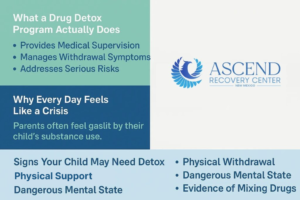
Signs Your Child May Need Detox Instead of Just “Getting Help”
You’ve probably tried the early steps already. Therapy. Tough love. Grounding. Second chances. Nothing’s sticking. And now you’re here—wondering if this is finally “bad enough” to get help.
Here are some signs that a drug detox program might be the safest first step:
- They experience physical withdrawal when they try to stop
- You’ve found evidence of mixing drugs (especially fentanyl or benzos)
- Their mental state changes rapidly or dangerously
- They’ve overdosed or been hospitalized
- They’re refusing outpatient help but clearly deteriorating
- They aren’t eating, sleeping, or functioning safely
You don’t have to wait for a tragedy. If your gut says things aren’t safe anymore, that’s a reason to act.
What Detox Looks Like at Ascend: From Chaos to Stabilization
At Ascend, we don’t expect your child to arrive “ready for recovery.” We’re here for when they’re still unsure. Still volatile. Still using.
Once admitted, our detox program includes:
- 24/7 medical supervision
- Medication-assisted withdrawal management
- Psychiatric and clinical evaluations
- Basic support and stabilization
- Planning for what comes next
This isn’t a locked-down hospital. It’s a safe, compassionate place where your child can begin to physically stabilize and emotionally reconnect—at their own pace.
If you’re looking for a drug detox program in Las Cruces, New Mexico, Santa Fe, or Rio Rancho, Ascend provides options for surrounding communities and will help you find the right path—even if it’s not with us.
You’re Not Expected to Have the Answers
When you call us, you don’t need to know what level of care your child needs. You don’t have to have their consent yet. You don’t even have to know what to say.
Just start the conversation.
We’ll ask:
- What are you seeing?
- What’s been tried?
- Are there safety risks today?
From there, we help assess whether detox is appropriate, coordinate next steps, and make sure you feel supported—not judged.
Because we know what it’s like to feel like the only adult left holding the pieces. And we want to be the first to say: you’re doing more than enough.
Detox Isn’t the End Goal—It’s the Doorway
The point of detox isn’t to “fix” your child in five days. It’s to open a door they couldn’t see while using.
Once someone is medically stable, they can start connecting with the real work of recovery. For some, that means residential treatment. For others, outpatient support, therapy, or trauma care.
Whatever the next step is, detox makes it possible by removing the immediate physical risk—and by giving families a chance to reset.
Even if your child isn’t ready to commit long-term, getting them into detox is often the beginning of them realizing they want more.
What If They Don’t Want Help Yet?
This is the most painful question of all.
If your child is legally an adult, your options feel limited. But you still have more power than you think. You can:
- Set boundaries around safety (like requiring medical assessment after overdose or erratic behavior)
- Call us to discuss intervention support
- Use natural consequences to move toward treatment readiness
- Take care of yourself so you can stay steady
We can’t promise immediate change. But we can promise to walk with you through whatever comes next.
FAQs: Understanding Drug Detox for Families in Crisis
What’s the difference between detox and rehab?
Detox is short-term medical stabilization focused on withdrawal management. Rehab (residential or outpatient) addresses long-term recovery and behavioral change. Detox prepares someone physically for deeper work.
How long does detox take?
Detox usually lasts between 3–7 days, depending on the substance(s) used and the individual’s medical needs.
Can my child refuse detox if they’re over 18?
Yes—but you can still take steps. Call us to explore intervention support, voluntary transportation, or crisis options. If they’re under legal guardianship, options widen.
Will they be locked in or forced to stay?
No. Detox at Ascend is voluntary, but structured and secure. We focus on safety and compassion, not punishment.
What happens after detox?
We’ll work with you and your child (when possible) to plan next steps, which may include residential treatment, intensive outpatient care, or mental health services.
Need to Talk It Through?
Call (888) 792-5442 or visit Ascend’s drug detox program in Albuquerque, New Mexico to speak with someone who understands the urgency—and the heartbreak—of parenting through crisis. You don’t have to figure this out alone. We’re ready when you are.
